

Across Australia, drones are now standard tools for construction, agriculture, media, surveying and inspection work. But if you want to earn an income from flying, you need more than a good drone and some hours on the sticks. You need CASA‑accredited training and a recognised licence.
Drone Training Hub gives you a clear, practical pathway from keen flyer to licensed commercial drone pilot. Through CASA‑accredited drone training, you learn how to fly safely, meet the legal requirements, and present yourself as a professional that clients and employers can trust.
“A drone licence is more than a card in your wallet; it’s proof that you can be trusted in shared airspace.” – Common aviation training principle
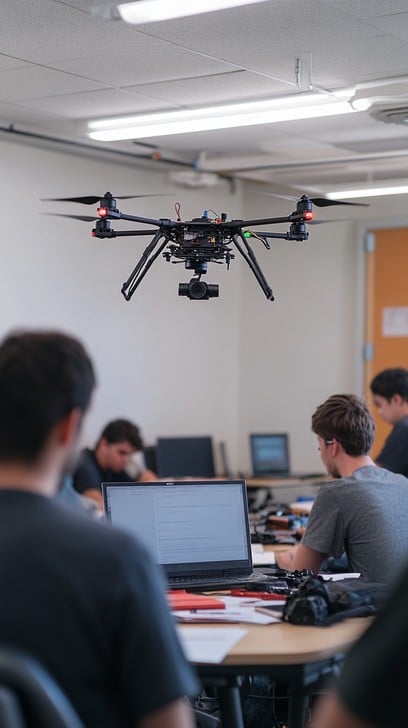
CASA, RePL And ReOC: The Rules Behind Commercial Drone Flying

The Civil Aviation Safety Authority (CASA) is Australia’s aviation safety regulator. CASA sets the rules for how Remotely Piloted Aircraft (RPA) operate in Australian airspace, from small quadcopters to large commercial systems.
You can read CASA’s drone information directly on the CASA website: CASA – Drones.
If you want to fly commercially (for any kind of payment or reward), the rules are clear:
- Most commercial pilots must hold a Remote Pilot Licence (RePL).
- Many businesses also need a Remote Operator’s Certificate (ReOC) to run more complex or ongoing operations.
- Flying without the right approvals can lead to significant fines, cancelled jobs and higher insurance risk.
There is a narrow excluded category for drones under 2 kg and some very simple, low‑risk work, but even then you must still follow CASA’s standard operating conditions. For many real‑world jobs, that exemption quickly runs out.
Drone Training Hub’s CASA‑aligned programs give you the RePL required to fly legally for work, and help you understand where a ReOC fits into your future plans. For a deeper overview of the rules, see Australian drone laws.
Why CASA‑Accredited Drone Training Matters
Plenty of skilled hobby pilots can fly a drone smoothly. CASA‑accredited training from a provider like Drone Training Hub adds everything the commercial world expects on top of that flying skill.
“Good drone pilots aren’t just good with the sticks; they know the rules, read the airspace and manage risk every single flight.” – Experienced RPAS instructor
1. You Fly Legally And Avoid Fines
Operating commercially without the correct licence can expose you to:
- CASA infringement notices and fines
- Insurance claims being denied after an incident
- Clients cancelling work when they check your credentials
With a CASA‑recognised Remote Pilot Licence (RePL), you have the paperwork to prove you meet the standard. You can show it to site supervisors, safety officers and clients whenever you sign in.
2. You Stand Out From Hobby Flyers
Employers and clients look for pilots who have:
- Formal CASA‑aligned training
- Documented knowledge of air law and airspace
- Assessed practical skills and safety practices
A RePL from Drone Training Hub signals that you take your responsibilities seriously and that you’re ready for professional work, not just weekend flying.
3. You Can Fly Larger And More Capable Drones
Without accreditation, you’re effectively limited to under 2 kg drones in very simple scenarios. CASA‑accredited training opens the door to:
- Heavier multi‑rotors used in infrastructure inspection and surveying
- Aircraft suited to agriculture, mining and environmental work
- Camera platforms used in film, television and advertising
These are the types of drones that sit behind higher‑paying jobs and long‑term contracts.
4. You Build Safe Habits From Day One

Good training makes safe operation feel routine. At Drone Training Hub, safety is not a separate add‑on module; it’s built into every part of the course:
- Risk assessment before every flight
- Structured pre‑flight and post‑flight checks
- Clear limits on when to fly, where to fly and when to say “no”
That approach protects you, your aircraft, your clients and people on the ground.
The Drone Training Hub CASA Commercial RePL Pathway
Drone Training Hub offers a blended CASA Commercial Remote Pilot Licence (RePL) course that suits people who are working, studying or changing careers. It combines flexible online theory with focused in‑person flight training and CASA‑approved assessments.
At Drone Training Hub, the full pathway is delivered under a CASA ReOC (RPA Operator’s Certificate) held by the training partner, so your qualification is nationally recognised.
A quick overview of the course stages:
| Stage | Focus | Mode |
|---|---|---|
| Stage 1 | RPAS theory and core knowledge | Online, self‑paced |
| Stage 2 | Practical flight training and procedures | In‑person, small‑group |
| Stage 3 | Assessment and CASA licence support | In‑person & remote |
Stage 1: Self‑Paced Online RPAS Theory
The first stage is an online course you can complete from anywhere in Australia, at your own pace. The material is written in clear, plain English, not technical jargon, and is fully aligned with CASA’s Part 101 Manual of Standards.
You’ll cover:
- Air law and pilot responsibilities – what CASA expects from commercial pilots
- Airspace and charts – how to read VTCs and understand where you can and can’t fly
- Meteorology – how wind, temperature, cloud and visibility affect drone performance
- Human factors – fatigue, workload, stress and how they affect your decision‑making
- Aircraft systems and performance – batteries, payloads, GNSS, control links and failure modes
- Mission planning and risk assessment – step‑by‑step planning for safe, repeatable jobs
- Normal, abnormal and emergency procedures – what to do when something doesn’t go to plan
- Navigation and radio basics – GPS concepts, situational awareness and standard radio phrases
- Operational decision‑making – making the right call when conditions change
Short quizzes, checklists and reference sheets help you lock in each topic and get ready for your theory assessment.
Throughout your studies, you can reach out to instructors for support and join Q&A sessions to clarify anything that doesn’t quite click.
Stage 2: Instructor‑Led Practical Flight Training

Once your online theory is complete, you move into in‑person practical training with Drone Training Hub instructors.
During this phase you’ll:
- Practise controlled take‑offs, landings and precise manoeuvres
- Plan and fly complete missions from briefing to debrief
- Apply normal operating procedures from your manual
- Work through realistic abnormal and emergency scenarios
- Build confidence flying in real NT and other Australian environments
Training is hands‑on and small‑group, so you get feedback as you fly, not days later. The focus is on giving you the skills you’ll actually use on job sites, not just in a test field.
Stage 3: Assessment And CASA Certification Support
To gain your RePL, you must pass both:
- A theory exam to show you understand the rules, responsibilities and procedures
- A practical flight assessment to confirm you can apply that knowledge safely in the air
Drone Training Hub guides you through the remaining steps, including paperwork and CASA submissions, until your Remote Pilot Licence (RePL) is issued.
From there, you can start working under an existing ReOC, or begin planning for your own ReOC with guidance from the team. More on that below.
What You Actually Learn: Inside A CASA‑Aligned Curriculum
Drone Training Hub’s curriculum is carefully aligned with CASA’s RPAS standards, so you graduate with the same foundation knowledge expected across the Australian industry.
Core learning areas include:
- Air Law & Responsibilities
How the regulations apply to you as a commercial pilot, including safety, privacy and record‑keeping. - Airspace & Charts
Understanding controlled, restricted and danger areas; operating near aerodromes; and working with NOTAMs and CASA advice. - Meteorology
Reading aviation weather products, assessing conditions, and deciding when it’s safe to fly. - Human Factors
Recognising fatigue, distractions and pressure, and putting controls in place so they don’t lead to poor decisions. - Aircraft Systems & Performance
How RPAS components work together, what can fail, and how to check that the aircraft is airworthy before each mission. - Mission Planning & Risk Assessment
Site surveys, hazard identification, risk controls and documenting your plan so you can repeat work safely. - Normal, Abnormal & Emergency Procedures
Standard procedures for take‑off, cruise and landing, plus pre‑planned responses for lost link, low battery, GNSS issues and more. - Navigation & Radio Basics
GPS, GNSS and situational awareness, along with core radio skills for operations where airband communication is required. - Operational Decision‑Making
Bringing all of the above together so you can make sound real‑time decisions in changing conditions.
This is the knowledge base that underpins every professional drone operation in Australia, regardless of aircraft type or industry.
Who Drone Training Hub Is Designed For

The Drone Training Hub style of training is built for real industry roles, not just theory exams. Typical students include:
- Career‑changers
People moving from trades, transport, tech, defence or other areas who want a clear pathway into paid drone work. - Construction, surveying and engineering professionals
Site managers, surveyors and engineers who need in‑house skills for mapping, progress photos, volumetrics and 3D models. - Agriculture and environmental teams
Farmers, agronomists and environmental officers using drones for crop health checks, water management and habitat monitoring. - Mining and inspection specialists
Staff involved in pit surveying, stockpile measurement and asset inspection who need safe access to hard‑to‑reach areas. - Content creators, media and film crews
Photographers, videographers and production companies who must hold a RePL to legally use aerial footage in commercial projects. - Public sector and emergency services
Councils, government agencies and response organisations building internal drone capability for inspection, monitoring and incident support. - Recreational pilots stepping up to commercial
Hobby flyers ready to turn their skills into a legitimate drone business, with the licences and knowledge to avoid fines.
“If you already fly for fun, formal training turns raw stick time into a career you can rely on.” – Commercial drone pilot mentor
Meet Your Instructors: Real Aviation Experience Behind Every Lesson
A training provider is only as strong as its instructors. Drone Training Hub works with highly experienced aviation professionals so you learn from people who have lived and worked under the same rules you’re training for.
Simon Denby – Regulatory And Advanced Operations Specialist
With more than 28 years in aviation, Simon Denby brings deep experience from both manned and unmanned operations.
Highlights of Simon’s background include:
- 16 years at CASA as a Senior RPAS Inspector, directly involved in developing and enforcing national standards for drone operations
- 12 years as a commercial manned aircraft flight crew member
- Specialist knowledge in:
- Beyond Visual Line of Sight (BVLOS) operations
- RPAS SORA 2 and 2.5 risk assessments and approvals
- Advanced operational safety and compliance
Simon also held senior roles with Alphabet’s drone delivery program, working on large‑scale unmanned systems at the forefront of the sector. His insight helps you understand not just what the rules say, but how they’re applied in real approvals and operations.
Michael Coyne – Chief Pilot And Industry Applications Expert
Michael Coyne, Chief Pilot at Drone Training Hub, has over 30 years of aviation experience across manned and unmanned aircraft.
Michael has flown and managed operations in:
- Construction and major infrastructure projects
- Mining and quarrying
- Surveying and mapping
- Asset inspection (including utilities and industrial sites)
- Film, TV and commercial media
- Agricultural aerial work
That range means your training is full of real examples: how to brief a client, what data they actually need, and how to deliver it safely and efficiently.
Michael also founded Fly Forward NT, a high school scholarship program that provides young people in remote and disadvantaged NT communities with access to quality drone training and clear pathways into aviation and technology careers.
CASA Alignment, Credentials And National Capability
When you study with Drone Training Hub, you’re training under a provider that operates with full CASA approval.
Key credentials:
- Training delivered under a CASA‑issued ReOC (RPA Operator’s Certificate), ReOC No. 0202
- Training partner with around 30 years of manned and 15 years of unmanned aviation experience
- Base in the Northern Territory with the ability to provide national training, including remote options for students across Australia
This means your RePL and any endorsements achieved through the program are recognised by CASA and respected by employers.
Pathways Beyond Your First RePL

Your Remote Pilot Licence is the starting point, not the finish line. Drone Training Hub can guide you towards more advanced roles and approvals as your career grows.
Potential next steps include:
- Aircraft endorsements
Training and assessment for heavier multi‑rotor, fixed‑wing or VTOL aircraft, each suited to different types of work. - Aeronautical Radio Operator Certificate (AROC)
Required if you need to make radio calls on aviation frequencies, particularly around controlled airspace. - ReOC and Chief Remote Pilot preparation
If you plan to run your own drone business or manage a fleet of pilots and aircraft, you’ll need an RPA Operator’s Certificate (ReOC). Instructors can help you understand the manuals, systems and safety cases required. - BVLOS and complex operations
With experts like Simon Denby involved, you gain insight into BVLOS operations and SORA‑based risk assessments used for long‑range inspection, survey and delivery projects.
CASA regularly updates its guidance, including documents like the RPAS and AAM regulatory roadmaps and plain English guides. A strong grounding through Drone Training Hub makes it far easier to keep up with these changes throughout your career.
Course Structure, Timing And Flexibility
Drone Training Hub’s CASA‑accredited course is structured for working adults and busy professionals.
- Online theory is self‑paced, so you can study around shifts, family and other commitments.
- In‑person assessments and flight training are typically scheduled over one week, held at the end of every two‑month period. This gives you clear targets without forcing you into a rigid weekly attendance model.
Because the theory and practical components are integrated, you don’t just cram for a test – you build skills gradually, then apply them in the field under instructor supervision.
“The best training programs respect that students have jobs, families and other commitments – flexibility is a safety tool too.” – Aviation training coordinator
Why Choose Drone Training Hub For CASA‑Accredited Drone Training
There are several reasons aspiring commercial pilots choose Drone Training Hub as their drone training hub – not just for the RePL, but for their broader career.
- Clear, plain‑English teaching
Complex topics like air law and risk assessment are explained simply, with a focus on how they apply to real operations. - Safety at the centre of every lesson
Risk management, airspace discipline and privacy are woven through each module, not treated as an afterthought. - Blended learning that fits real life
Self‑paced theory plus focused in‑person flight days mean you can progress without putting the rest of your life on hold. - Direct support from experienced instructors
You can ask questions by email and in Q&A sessions, instead of being left alone with a textbook. - Strong industry focus
Training examples and scenarios reflect work in construction, mining, agriculture, media and inspection, especially in NT and regional conditions.
To see how this fits into your long‑term plans, you can also explore the article on how RPAS training can grow your career on the Drone Training Hub website.
Take The Next Step Towards Being A Licensed Commercial Drone Pilot
CASA‑accredited training is the foundation of a safe, legal and sustainable drone career. It protects you from fines, raises your professional profile and gives you the skills to handle real‑world jobs with confidence.
At Drone Training Hub, you’ll gain:
- Solid knowledge of air law, airspace and drone systems
- Practical flying skills tested under CASA‑aligned standards
- A recognised Remote Pilot Licence (RePL) so you can work commercially across Australia
Contact Drone Training Hub today to enrol and start your career as a licensed commercial drone pilot.
FAQs About CASA‑Accredited Drone Training
1. Is CASA Accreditation Mandatory For Commercial Drone Work?
Yes. To fly drones commercially in Australia, you generally need a Remote Pilot Licence (RePL), and many operators also require a Remote Operator’s Certificate (ReOC).
There are limited exclusions for drones under 2 kg doing very simple work, but those operations still have strict conditions. For most serious commercial operators, a RePL is the expected minimum standard.
2. Can I Fly Commercially Without CASA Accreditation?
You can only do limited commercial work without formal CASA accreditation if:
- Your drone weighs under 2 kg, and
- You operate strictly within CASA’s standard operating conditions, and
- Your work is simple, low‑risk and outside controlled airspace and restricted areas
However, many clients, companies and insurers insist on pilots holding a RePL, regardless of weight. CASA‑accredited training through Drone Training Hub removes doubt and opens far more work opportunities.
3. How Long Does CASA RePL Training With Drone Training Hub Take?
The Drone Training Hub course is designed to be flexible:
- Online theory is self‑paced, so you can complete lessons at a speed that suits you.
- In‑person flight training and assessment usually run over one week, held at the end of every two‑month cycle.
This structure lets you balance study with work or family, while still giving you clear dates to aim for.
4. Do I Need A ReOC As Well As A RePL?
You only need a ReOC if you plan to run your own drone business or manage a fleet of pilots and aircraft. Many pilots start by:
- Gaining their RePL with Drone Training Hub
- Working under an existing ReOC (for an employer or contractor)
- Later pursuing a ReOC when they’re ready to run their own operation
Drone Training Hub can explain what a ReOC involves and how to prepare if that’s part of your long‑term plan.
5. Where Can I Train From?
Because the theory stage is online, you can start your CASA‑accredited training from anywhere in Australia. Practical training blocks are run from Northern Territory locations and, by arrangement, other regions, with a focus on national capability.
If you’re unsure how the schedule works for your area, you can contact Drone Training Hub directly through the main website at Drone Training Hub for current dates and options.